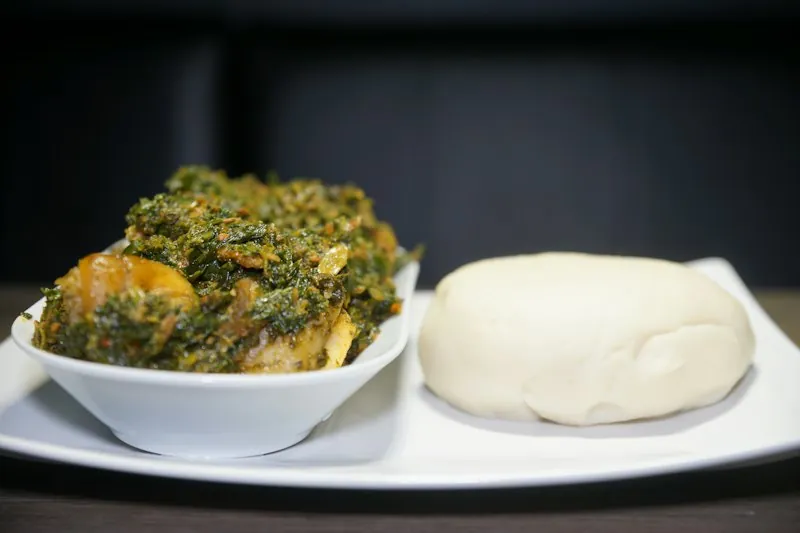
Efo riro is a rich, deeply savory Nigerian stew of leafy greens cooked in a base of blended peppers and palm oil, then finished with smoked fish and, often, stockfish, crayfish and assorted meat. It is a classic in Nigerian cooking, and it is thicker than most soups, made to be scooped up with a piece of soft pounded yam. Efo is the Yoruba word for leafy greens, and the stew traditionally uses leaves such as efo tete or efo shoko. The result is deliberately rich: the palm oil carries the flavor of the peppers, and the smoked fish and crayfish give it depth without any long simmering.
This version serves six and takes about 40 minutes, because the greens are folded into the finished pepper base rather than boiled for a long time. In the US, fresh or frozen spinach makes an excellent stand-in for the traditional leaves, and the recipe shows how to prepare each one so the stew stays thick and never watery. If you add beef or tripe, allow extra time for the meat to turn tender, or use a pressure cooker.
To eat it the classic way you will need one 2 lb bag of pounded yam flour, which makes about 7 servings, so a single bag covers six people with a little left over. The rest of the pantry is simple: peppers, tomato, onion, palm oil, crayfish and fish. Pounded yam flour cooks in about 2 minutes at the stove, with no pounding. If you have never made it before, our guide to how to make pounded yam with flour goes through the technique step by step.
Ingredients
For the fish, stockfish and optional meat
- 8 oz (225 g) smoked or dried fish, such as bonga fish or panla fish, cleaned and broken into large pieces, bones removed
- 1 piece stockfish (about 3 oz / 85 g), soaked in hot water until soft (optional)
- 1 lb (450 g) beef or assorted meat, cut into small pieces (optional)
- If cooking meat or stockfish: 1 small onion, quartered, 1 seasoning cube, 1 teaspoon salt and 2 cups (480 ml) water
For the stew
- 1½ lb (680 g) fresh spinach, washed and roughly chopped; or two 10 oz (280 g) packages frozen chopped spinach, thawed
- ½ cup (120 ml) palm oil
- 3 large red bell peppers (about 1 lb / 450 g), seeded and chopped
- 1 plum (Roma) tomato, chopped
- 1 to 3 Scotch bonnet (habanero) peppers, to taste; remove the seeds for a milder stew
- 2 medium onions: 1 chopped for blending, 1 thinly sliced
- 1 tablespoon iru (fermented locust beans), optional
- 2 tablespoons ground crayfish
- 1 seasoning cube (such as Maggi or Onga), crushed
- ½ to 1 cup (120 to 240 ml) stock or hot water
- Salt, to taste
For the pounded yam
- 6 cups (about 1 lb 11 oz / 750 g) pounded yam flour, from one 2 lb (900 g) bag; the bag holds about 7 servings, so you will have about a cup left over
- 7½ to 9 cups (about 1.8 to 2.1 liters) water, for boiling: 1¼ to 1½ cups for every 1 cup of flour
- A little extra hot water from the kettle, for adjusting the texture
Method, step by step
- If you are using meat or stockfish, put it in a pot with the quartered onion, 1 seasoning cube, 1 teaspoon salt and 2 cups water, then simmer covered until tender: about 30 minutes for small pieces of beef and softened stockfish, longer for tripe. If you are using only smoked fish, skip this step.
- Prepare the greens: put fresh chopped spinach in a colander, pour a kettle of boiling water over it, let it drain, then squeeze out as much water as you can with your hands. Thawed frozen spinach only needs squeezing; dry greens are what keep the stew thick.
- Blend the bell peppers, tomato, Scotch bonnets and one of the onions into a coarse puree, using as little water as possible, and pour off any watery liquid that separates.
- Warm the palm oil in a large pot over medium heat for 1 to 2 minutes, until it is liquid and fragrant but not smoking. Add the sliced onion and the iru if using, and fry for 2 to 3 minutes until the onion softens.
- Pour in the blended pepper and cook, stirring occasionally, for 12 to 15 minutes, until the water has cooked off, the paste has thickened and darkened, and red oil floats on top. This is the flavor base of efo riro, so do not rush it.
- Stir in the crayfish, the crushed seasoning cube and a little salt, then add the smoked fish, plus the stockfish and meat if using, with ½ cup of their stock. Simmer for 5 minutes so the flavors come together, breaking the fish into large chunks.
- Add the squeezed greens in handfuls, stirring after each so they are coated in the base, and cook uncovered for 3 to 4 minutes, until just heated through. Taste and adjust the salt and heat; the finished stew should be thick and glossy, with oil visible, not soupy.
- About 10 minutes before you want to eat, bring 7½ cups of water to a rolling boil in a large, heavy pot and lower the heat. This is the lower end of the ratio (1¼ cups water per cup of flour), with hot water on hand to adjust.
- Add the 6 cups of pounded yam flour gradually, stirring with a wooden spatula. Turn and fold the dough against the side of the pot for about a minute until smooth and stretchy, adding a splash of hot water if it feels too stiff.
- Shape the pounded yam into 6 smooth balls (a damp bowl or wet hands help) and serve hot, with the efo riro spooned alongside.
Tips for a better pot
- Efo riro is a thick stew, not a soup. Squeezing the greens dry and adding only a splash of stock is the difference between a rich stew and a watery one.
- Scotch bonnets are very hot. For a milder stew, use one and remove the seeds, then taste at the end and add more finely chopped pepper if you want it hotter.
- Let the pepper base cook until the oil separates and floats on top. If it is still bright, wet and pale when the greens go in, keep frying for a few more minutes first.
- A handful of chopped ugu leaves can go in with the spinach for a more traditional mix; add it at the same time, and squeeze it dry in the same way.
- Cook the pounded yam last, when the stew is ready. It takes about 2 minutes and is best hot from the pot.
- Short on pot space? Make the pounded yam in two batches of 3 cups flour with 3¾ to 4½ cups water each, and keep the first batch covered while you make the second.
Serving. Bring the efo riro to the table in the pot, spoon it over or beside a warm ball of pounded yam, and make sure everyone gets some fish. Because the stew is thick, it clings to the yam nicely: pinch off a small piece of yam, press a hollow into it, scoop up some greens and fish, and swallow it without much chewing. Efo riro is also commonly eaten with other swallows such as amala and eba, or simply with rice or boiled yam, so leftovers rarely go to waste. Fried plantain on the side is a popular addition, and a cold drink helps if you were generous with the Scotch bonnets.
Leftovers and make-ahead. A few notes on planning ahead:
- Efo riro is often even better the next day, once the flavors have settled together.
- Cool the stew quickly, refrigerate it in a covered container and eat it within three to four days.
- Reheat over low heat with a small splash of water; avoid boiling it hard.
- Make the pounded yam fresh, right before serving, when it is soft and hot.
The pounded yam flour. The pounded yam in this recipe comes from one 2 lb bag of pounded yam flour, priced at $9.99, which works out to about $1.40 a plate. Our flour is made only from Benue yams: peeled, parboiled, dried, milled fine and sifted, with no preservatives, food coloring or chemicals added. It is one ingredient, 100% yam, packed in resealable, moisture-resistant bags with the best-before date printed on every one. Many instant "poundo" flours are blends of yam and other starches, so check the label, and remember that pounded yam flour is not elubo, which is the flour used for amala. If your household eats yam soups regularly, the 5 × 2 lb bundle or the 10 lb bag both qualify for free shipping within the continental US. Orders ship within 24 to 48 hours and usually arrive in 2 to 5 business days, and subscribing saves 10%, with a reminder every 4 weeks to reorder in one click and no obligation to keep going.
Where to get the ingredients. The soup ingredients are coming to Afri Foods Basket soon, including palm oil, crayfish, dried pepper, stockfish, smoked fish such as bonga fish and panla fish, ugu leaf to mix in with your spinach, and seasoning such as Maggi cubes and Onga. Until they arrive, many of them can be found at African grocery stores, and you can follow the full list, with a Notify me option, in the coming soon section of the store. Restaurants and caterers who cook efo riro in volume can ask for trade pricing on the 40 lb case through the wholesale form.
More soups to try. Try pounded yam and egusi soup for a thick, seed-thickened pot, pounded yam and ogbono soup when you want something silky, or pounded yam and okra soup for a quick weeknight meal. Whichever you pick, the pounded yam comes together the same way, using the same ratio of 1¼ to 1½ cups of boiling water for every cup of flour, so once you have made it once, it becomes second nature.
Frequently asked questions
Can I make efo riro with frozen spinach?
Yes. Use two 10 oz packages of frozen chopped spinach for six people, thaw them completely, and squeeze them very dry in a clean towel or your hands before adding them to the pepper base. Frozen spinach is already softened, so it needs only 2 to 3 minutes in the pot.
Why is my efo riro watery?
The usual causes are wet greens, a puree that was too thin, or a base that did not cook long enough. Squeeze the spinach very dry, blend the peppers with little or no water, and fry the base until the oil floats on top before the greens go in. Then add stock only a splash at a time.
Can I make efo riro without meat?
Yes. Smoked or dried fish, crayfish and a little stockfish give the stew plenty of flavor, and many cooks make efo riro with fish alone. If you skip the meat, you can also skip the stock step and use hot water with the seasoning cube for the small splash of liquid the recipe needs.
What else can I eat efo riro with?
Pounded yam is a favorite, and it is quick to make from flour, but efo riro is also commonly eaten with other swallows such as amala and eba, and with boiled yam or rice. Leftovers reheat well on low heat with a splash of water, so it is worth making a full pot.