To learn how to make pounded yam with flour, you only need three things: boiling water, pounded yam flour and a wooden spatula. Use about 1¼ to 1½ cups of boiling water for every 1 cup of flour, add the flour gradually while stirring, then turn and fold the dough against the side of the pot for about a minute. It is ready in roughly 2 minutes, smooth, white and stretchy, and it goes straight from the pot to the table with your favorite soup.
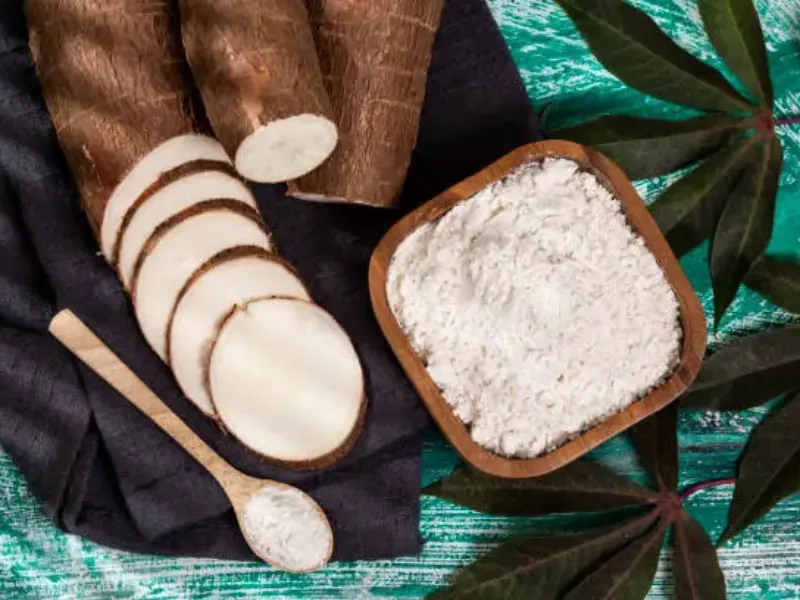
If you have ever eaten iyan made the traditional way, boiled yam pounded in a mortar until it turns elastic, you know how good it is and how much work it takes. Pounded yam flour does the hard part for you. The yam has already been peeled, parboiled, dried, milled fine and sifted, so all that is left is combining it with hot water. This guide gives you the full method, a ratio chart for 1 to 8 people, and a troubleshooting section for the four problems every cook meets sooner or later: lumps, stiffness, softness and stickiness.
What you need
You do not need any special equipment. Here is the short list:
- Pounded yam flour. Plan on about 1 cup (roughly 125 g) per person. Our 2 lb bag holds enough for about 7 servings.
- Water. About 1¼ to 1½ cups for every cup of flour, plus a little extra kept hot in a kettle.
- A pot. A nonstick or heavy-bottomed pot with a wide base is easiest, because the dough is less likely to stick or scorch.
- A wooden spatula. A sturdy wooden spatula or wooden spoon lets you press and fold the dough against the side of the pot.
- A bowl or cling film for shaping. A small bowl rinsed with water, or a piece of cling film, helps you form smooth balls.
- Your soup, ready and hot. Pounded yam is best eaten as soon as it is made, so have the soup waiting.
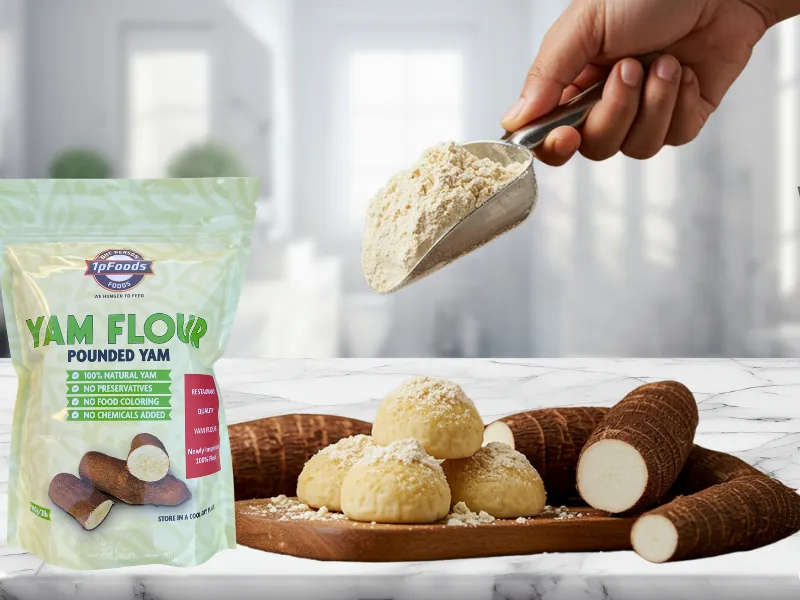
One note on the flour itself. The flour we sell is 100% yam, made only from Benue yams, with nothing else added. Because it is pure, the dough cooks to a clean white color and a properly stretchy texture. If you are comparing brands, our buyer's guide to pounded yam flour explains what to look for on the label.
How to make pounded yam with flour: step by step
Follow these steps in order. The whole process, from the moment the water boils, takes about 2 minutes.
- Measure your flour and water. Use 1 cup of flour per person. For every cup of flour, measure 1¼ to 1½ cups of water. Start with the smaller amount of water if you like your pounded yam firm, and the larger amount if you like it softer.
- Boil the water. Pour the water into your pot and bring it to a rolling boil. Boil a little extra in a kettle and keep it close by. You may want a splash later.
- Lower the heat. Turn the heat down to low so the dough does not stick or catch on the bottom of the pot.
- Add the flour gradually. Sprinkle the flour into the hot water a handful at a time, stirring with your wooden spatula as you go. Do not tip the whole measure in at once. Adding it gradually is the single best way to avoid lumps.
- Turn and fold. Once all the flour is in, use the spatula to turn and fold the dough against the side of the pot, pressing as you go. Keep this up for about a minute. The dough will pull together and turn smooth and stretchy.
- Adjust if needed. If the dough is too stiff, add a splash of hot water and keep turning until it loosens. Add only a little at a time.
- Shape it. Scoop out a portion, place it in a rinsed bowl or on a piece of cling film, and shape it into a smooth ball. Repeat for each serving.
- Serve hot. Put the ball on a plate beside your soup, or in a small bowl, and eat while it is hot.
That is the whole method. The reason it works so quickly is that the yam was parboiled before it was dried. Hot water only has to wake it up, not cook it from raw.
Ratio chart: cups of flour and water for 1 to 8 people
This chart uses 1 cup of flour (about 125 g) per person and 1¼ to 1½ cups of boiling water per cup of flour. Use the lower water figure for firmer pounded yam and the higher figure for softer.
| People | Flour (cups) | Flour (approx. grams) | Boiling water (cups) |
|---|---|---|---|
| 1 | 1 | 125 g | 1¼ to 1½ |
| 2 | 2 | 250 g | 2½ to 3 |
| 3 | 3 | 375 g | 3¾ to 4½ |
| 4 | 4 | 500 g | 5 to 6 |
| 5 | 5 | 625 g | 6¼ to 7½ |
| 6 | 6 | 750 g | 7½ to 9 |
| 7 | 7 | 875 g | 8¾ to 10½ |
| 8 | 8 | 1,000 g | 10 to 12 |
Some people like to serve a bit more, especially for hungry adults or teenagers. If that sounds like your table, add an extra half cup of flour per person and scale the water in the same proportion. For more on portions, and how many people each pack feeds, see our guide to how much pounded yam flour per person.
A worked example: pounded yam for five
Say you are cooking dinner for five. That is 5 cups of flour, which is about 625 g (5 times 125 g). Your water is 5 times 1¼ cups, or 6¼ cups, up to 5 times 1½ cups, or 7½ cups. A sensible starting point is 6½ cups of boiling water. Keep a cup or so of extra hot water on the side. Add the flour a handful at a time, turn and fold for a minute, and adjust. A 2 lb bag holds about 7 servings, so this dinner uses 5 of them and leaves about 2 cups of flour in the bag for another day.
How to make pounded yam without lumps
Lumps are the number one complaint about instant pounded yam, and they are almost always avoidable. If you want pounded yam without lumps, these habits make the difference:
- Use water that is actually boiling. The flour needs to meet hot water at once to hydrate evenly.
- Add the flour a little at a time. A big heap dropped into the pot forms a dry core that the water cannot reach.
- Stir while you add. Keep the spatula moving as the flour goes in.
- Press the dough against the side of the pot. Turning and folding does more than mixing. It presses out small lumps as you work.
- Use a wide pot. A pot that is too narrow makes it hard to turn the dough.
- Keep the heat low. Too much heat dries the bottom layer and creates hard bits.
- Use a fine flour. Our flour is milled fine and sifted, which helps it mix evenly.
Troubleshooting: how to fix common problems
My pounded yam is lumpy
Small lumps can usually be worked out. Lower the heat, add a splash of hot water and press the dough against the side of the pot with the back of your spatula, turning and folding for another 30 to 60 seconds. If you are cooking a big batch, small lumps are easier to smooth out when you work in two smaller pots. Next time, add the flour more slowly and keep stirring as you pour.
My pounded yam is too stiff
Stiff dough means there is not enough water for the amount of flour. Add a splash of hot water, not cold, and keep turning and folding until the dough relaxes. Add it a little at a time, because it is easy to overshoot. Next time, use the higher end of the range, 1½ cups of water per cup of flour.
My pounded yam is too soft
If the dough feels runny and will not hold a shape, you used more water than the flour could absorb. Return the pot to low heat and turn the dough for a further minute. Stirring over gentle heat lets the mixture come together. If it stays soft, sprinkle in a little extra flour and work it through. Next time, aim for the lower end of the range, 1¼ cups of water per cup of flour.
My pounded yam is sticky
Sticky dough usually comes down to two things: too much water, or shaping with dry hands and a dry bowl. Work over low heat for a moment to firm it up. When shaping, rinse your bowl with water, or use cling film, so the dough slides out cleanly. A nonstick pot also helps.
The bottom of the pot is scorched
The heat was too high, or the dough sat without being turned. Do not scrape the burnt layer into your dough. Lift the good dough out and leave the burnt layer behind. Next time, keep the heat on low from the moment you add the flour.
Shaping and serving pounded yam
Shaping is the last small skill, and it makes the plate look right. Rinse a small bowl with water and shake it out, spoon in a portion of dough, then rotate the bowl in your hands (or twist the cling film closed) until you have a smooth ball. Turn it out beside the soup. Some cooks flatten the top slightly and make a small dip for the soup to sit in.
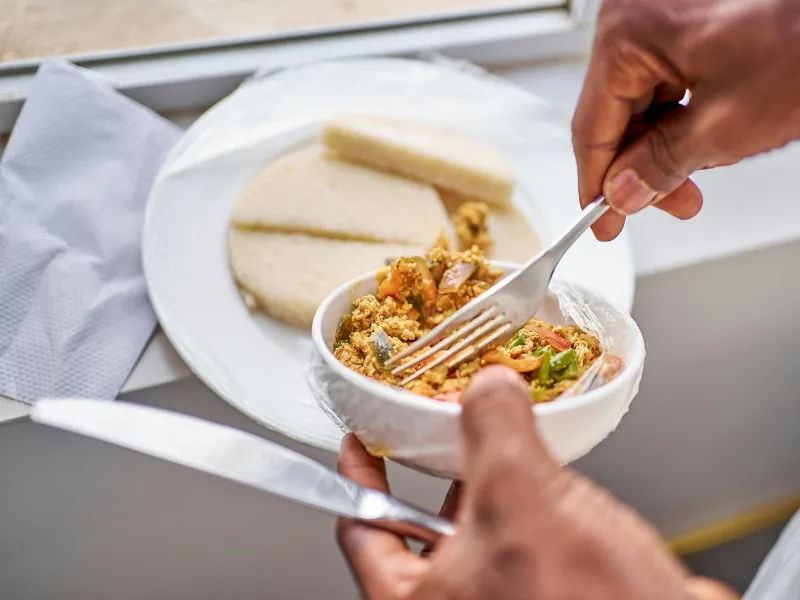
Pounded yam is a swallow, so it is eaten by pinching off a small piece with your fingers, rolling it, making a dent with your thumb, scooping up some soup and swallowing it without chewing much. Wash your hands first, and keep a small bowl of water nearby for rinsing your fingers as you eat.
Cooking pounded yam for a crowd
The ratio holds no matter how many guests you have, but large amounts of dough are heavy to turn. When you are cooking for a party, a family gathering or a church event, it is easier to make two or three smaller batches than one huge pot. Keep each batch to the amount you can comfortably turn and fold, and keep the soup hot and ready. Because each batch takes only about 2 minutes, your guests never wait long. If you cook for a restaurant, catering business or shop, our guide to buying pounded yam flour wholesale covers the 40 lb case.
Common mistakes to avoid
- Adding all the flour at once. Add it gradually.
- Using lukewarm water. The water must be boiling when the flour goes in.
- Measuring flour by eye. Use a measuring cup, especially on your first few tries.
- Adding cold water to fix stiffness. A splash of hot water is what you want.
- Making it too far ahead. It takes about 2 minutes, so cook it just before you eat. Only make what you will eat, and do not return unused cooked dough to the bag of flour.
- Leaving the bag open. Close the resealable bag after each use. Our guide to storing pounded yam flour has the details.
What to serve with pounded yam
Pounded yam is mild on purpose. It is there to carry a flavorful soup or stew, and the classic partners are egusi, efo riro, ogbono, okra, edikang ikong, afang and oha. If you want twelve ideas at once, read what to eat with pounded yam. We are also adding dried fish, soup leaves, thickeners, spices and palm oil to the shop over the next few months. You can see the full list and ask to be notified on the coming soon section.
If you would like a quick refresher on the method, the short version is on the how it works section of our home page.
Make your first batch tonight
Our pounded yam flour is 100% yam from Benue, milled fine and sifted, and it cooks in about 2 minutes. Order a 2 lb bag to try it, or take the 10 lb bag for free shipping and about 36 servings. Subscribe and save 10%: we remind you every 4 weeks so you can reorder in one click, and you can skip or cancel any time.
Frequently asked questions
What is the ratio of pounded yam flour to water?
Use about 1¼ to 1½ cups of boiling water for every 1 cup of flour. Use the lower amount for firmer pounded yam and the higher amount for softer. If the dough is too stiff, add a splash of hot water while you turn and fold it.
How long does it take to make pounded yam with flour?
About 2 minutes once the water is boiling. Add the flour gradually while stirring, then turn and fold the dough against the side of the pot for about a minute. Have your soup ready before you start, since pounded yam is best served hot.
Why is my pounded yam lumpy?
Lumps usually appear when the flour goes in too fast, the water is not hot enough, or the dough is not pressed against the pot. Add the flour a handful at a time while stirring, then press and fold. A splash of hot water and gentle heat help smooth out small lumps.
How much flour do I need per person?
Plan on about 125 g, or roughly 1 cup, per person. A 2 lb bag gives about 7 servings, and a 10 lb bag gives about 36. For a hungry crowd, add a little extra. The ratio chart above shows quantities for 1 to 8 people.
Can I make pounded yam ahead of time?
It is best made fresh, and since it takes only about 2 minutes, that is easy to do. Cook what you will eat and serve it hot. Do not return unused cooked dough to your bag of flour. Keep the flour itself sealed and dry between uses.