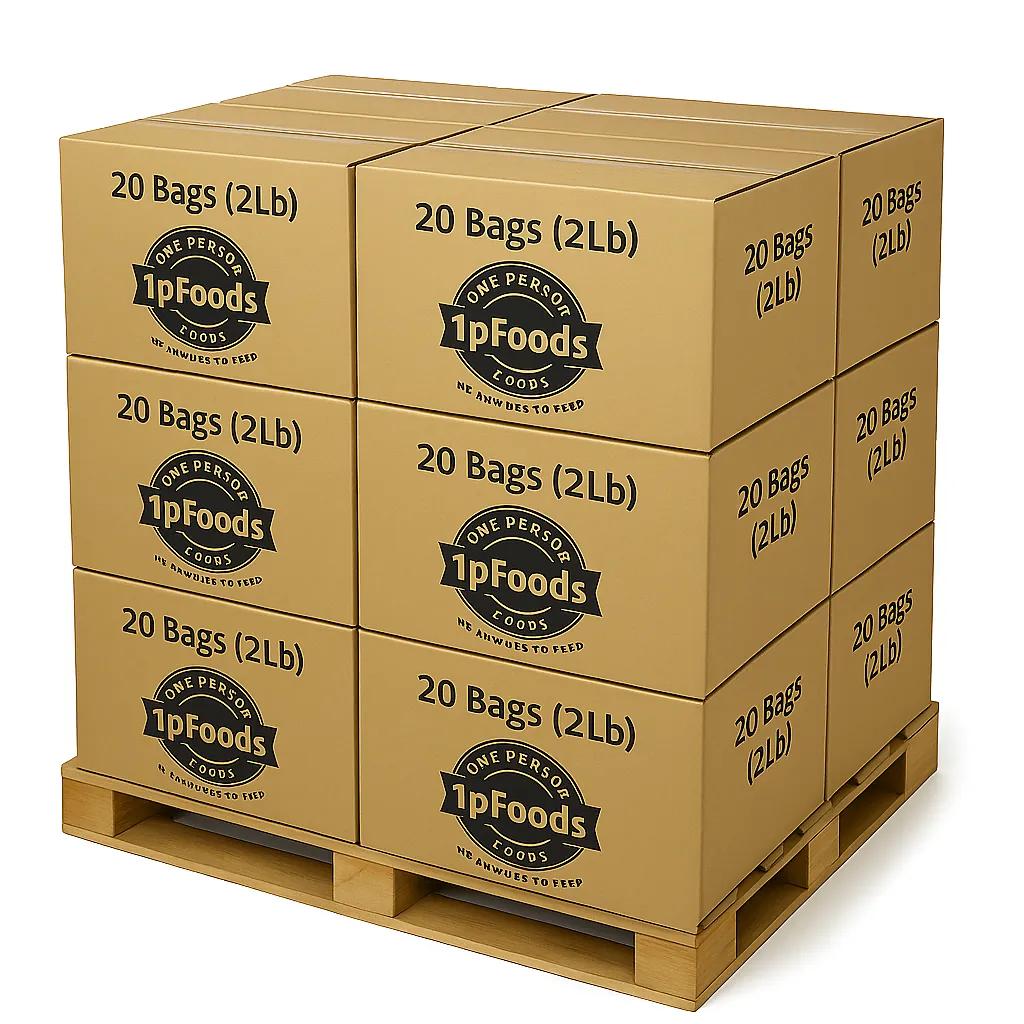
If you run a restaurant, a catering business or an African grocery store and you are looking for pounded yam flour wholesale, the option to know about is the 40 lb case: 20 bags of 2 lb (900 g) pounded yam flour, packed together and sold at trade prices. We do not publish trade prices. Instead, you request the price list through the wholesale form, by email at hello@afrifoodsbasket.com, or by phone at (734) 219-0258, and we quote for your business. This guide explains how the case works, how to think about cost per plate, and how to plan and store your stock.
It is written for people who buy flour for a living: chefs who put iyan on the menu every day, caterers who need it to turn out the same at every event, and store owners who want a dependable product on the shelf. It is also honest about what we can and cannot say in a blog post. Prices and terms are agreed directly, so this page focuses on everything that helps you decide before you ask.
Pounded yam flour wholesale: what you are buying
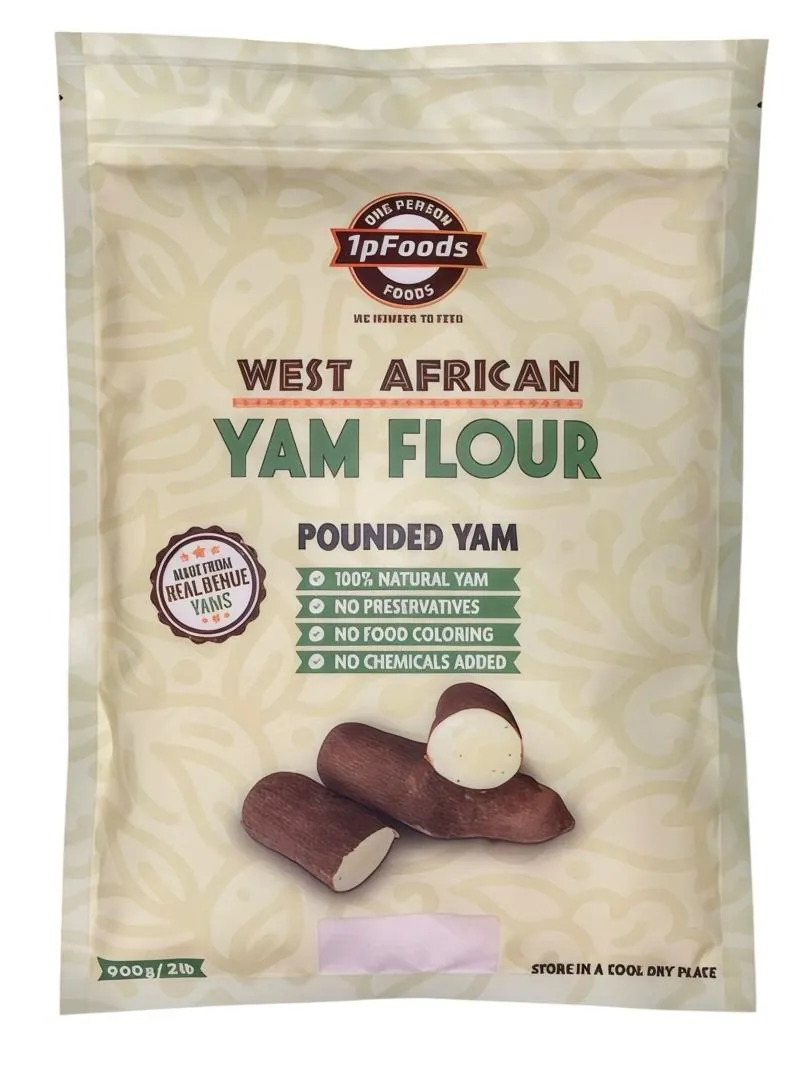
The product is the same one home cooks buy from us: pounded yam flour under the 1pFoods brand, sold by Afri Foods Basket. It is made from one ingredient only, yam, and only from Benue yams grown in Benue State, Nigeria. The yams are peeled, parboiled, dried, milled fine and sifted. There are no preservatives, no food coloring and no chemicals added.
The trade format is the 40 lb case, made up of 20 individual 2 lb bags. Each bag is resealable and moisture-resistant, and the best-before date is printed on every bag. That last detail matters more in a commercial setting than at home, and we come back to it in the storage section below.
| Detail | What it means for your business |
|---|---|
| 40 lb case | 20 bags of 2 lb (900 g), or about 18 kg of flour per case. |
| Individual 2 lb bags | Open one bag at a time. The rest stay sealed and protected. |
| Single ingredient | Yam only. No preservatives, coloring or chemicals added. |
| Benue yams | A single named origin, which helps keep the product consistent from order to order. |
| Best-before date on every bag | Easy stock rotation, shelf by shelf and bag by bag. |
| Trade pricing | Quoted through the wholesale form, email or phone. |
Who buys pounded yam flour in bulk
The people who ask us about cases tend to fall into four groups, and each one uses the flour a little differently.
Restaurants
For a Nigerian or West African restaurant, pounded yam is a dish diners notice immediately when it is done well: it has to be smooth, stretchy and hot every time. Because the flour cooks in about 2 minutes, it also suits a busy pass: portions can be made to order without a long wait at the table.
Caterers
For weddings, naming ceremonies, funerals, church events and office lunches, pounded yam is often the centerpiece. Caterers need to predict portions accurately and get the same result whether they are cooking for 30 or 300. A case gives you a known quantity to plan around.
African grocery stores
Stores need a product their customers recognize and trust, in a size that sells. The 2 lb bag is a practical shelf size, and a case is 20 of them. Because the ingredient list is one word, shoppers who check labels can see for themselves what they are buying.
Community kitchens and event organizers
Groups that cook for community gatherings, student associations or fundraising meals can use the same case arithmetic. Twenty bags at about 7 servings each is a helpful planning number for a big pot lunch.
Why the 40 lb case is built from 2 lb bags
You might expect a wholesale product to be one big sack. There are good reasons to prefer a case of smaller sealed bags, particularly for a kitchen or a shop.
- Less exposure. Every time a bag is opened, air and humidity get in. Twenty small bags means nineteen of them stay sealed while you work through the first.
- Easy to handle. A 2 lb bag is light and easy to carry to the prep station. Nobody in the kitchen has to lift a heavy sack or scoop out of a deep container.
- Clean portioning. A 2 lb bag holds about 7 servings, so you can plan a shift around whole bags. If you are expecting 14 portions, two bags is the answer.
- Less waste. If a bag is damaged or a batch runs short, the loss is one small bag, not a whole sack.
- Shelf-ready for stores. Individual bags can go on a shelf one at a time, and the printed best-before date is on each one.
- Simple counting. Stock counts are easy when everything comes in identical bags: a case is 20, half a case is 10.
Consistency: the real reason kitchens stay with one flour
If you talk to cooks who serve pounded yam every day, consistency comes up before price. A flour that cooks up slightly different every week forces the kitchen to keep adjusting water, timing and stirring. That means wasted product and inconsistent plates.
Three things help you get the same result every time.
A one-ingredient flour
Many instant "poundo" flours on the market are blends, often yam cut with cassava, potato flakes or other starches. Blends can vary in how they cook, how stretchy they turn out and how they hold at the table, so it pays to check the ingredient list on any flour you are considering. Our flour is 100% yam, so what is on the label is what is in the pot. Our guide to pounded yam flour vs poundo vs elubo explains how to read those labels.
A single source and a consistent process
Our flour is made only from Benue yams. The process is the same every time: peeled, parboiled, dried, milled fine and sifted. Parboiling before drying is what lets pounded yam flour cook up white and stretchy, in contrast to elubo, which is made from raw dried yam and cooks into brown amala. A kitchen that wants iyan on the menu is buying the parboiled kind.
A written house recipe
The best way to make the result repeatable is to write down the ratio and the method and make sure everyone in the kitchen follows it. The starting point is about 1¼ to 1½ cups of boiling water for every 1 cup of flour, with the flour added gradually while stirring with a wooden spatula. Turn and fold for about a minute against the side of the pot, add a splash of hot water if the dough is too stiff, and shape. The full method, with a ratio table and fixes for lumps, is in our guide to how to make pounded yam with flour. Test the ratio once with your own pots and your own portion size, then make it your house standard.
Cost-per-plate thinking
The price on a quote is only half the story. What matters to a restaurant or caterer is what the flour costs for each plate that leaves the kitchen. The calculation is short, and it works for any supplier.
- Portions per case. A 2 lb bag holds about 7 servings at about 125 g (roughly 1 cup) of flour per person. A case has 20 bags, so it holds about 140 servings (20 x 7).
- Flour cost per portion. Divide the case price on your quote by 140.
- Compare it to your menu price. Divide the flour cost per portion by what you charge for the plate or the swallow portion. That gives the flour's share of your menu price.
- Adjust for your real portion. If your kitchen serves a larger portion than 125 g, use your own portion weight. The case holds about 18,000 g, so divide 18,000 by your portion weight in grams to get portions per case.
For reference, at retail the flour works out to about $1.40 a plate. Trade pricing is quoted separately, so run the numbers again with your own quote in hand. If you like, a simple worksheet does the job:
| Line | How to work it out |
|---|---|
| Portions per case | 18,000 g divided by your portion weight in grams (about 144 at 125 g; we use about 140 for planning) |
| Flour cost per portion | Case price from your quote, divided by portions per case |
| Flour share of the menu price | Flour cost per portion, divided by the menu price of the plate |
| Cost of waste | Add a margin for portions that come back or batches you remake |
One more point in favor of a one-ingredient flour: it is easier to get a repeatable portion cost, because the flour behaves the same way batch after batch and there is less remaking.
How many cases will you need?
Planning purchases starts with an honest count of portions. Use the table below as a rough guide, assuming about 140 portions per case and four weeks in a month. Real numbers will be slightly different depending on your portion size and how much you make to order.
| Portions per week | Portions per month (4 weeks) | Cases per month (divide by 140) |
|---|---|---|
| 50 | 200 | About 1.5 |
| 100 | 400 | About 3 |
| 200 | 800 | About 6 |
| 400 | 1,600 | About 11 to 12 |
Round up and leave a small buffer. It is far easier to be a few bags over than to run out on a Saturday. And remember to account for events: a single large booking can add a big spike to an ordinary week.
For a household-size cross-check of the same arithmetic, our guide to how much pounded yam flour per person shows how the portion size and the bag sizes fit together.
Standing orders and planning your reorders
Once you know roughly how much you use, the sensible next step is to stop ordering at the last minute. A regular, planned order is good for you (no emergency runs, a steady supply, easier budgeting) and it is easier for us to plan around too.
When you request your price list, tell us how often you would expect to order and about how many cases each time, and ask what a repeating arrangement could look like. Retail customers can already use Subscribe & save, which gives 10% off plus a reminder every 4 weeks to reorder in one click, and lets you skip or cancel at any time. For trade volumes, terms are agreed with you directly through the wholesale route.
Some practical habits that make reordering easy:
- Set a reorder point. Decide the number of bags at which you place the next order, for example when you are down to one case.
- Track usage for a month. Count bags opened each week. Two or three weeks of data are enough to see a pattern.
- Plan for peaks. Holidays, weddings and big community weekends need extra cases ordered ahead of time.
- Ask about timing. Delivery times for trade orders are confirmed with your quote. Build your reorder point around them.
Storing cases in a restaurant kitchen or a shop
Good storage protects your investment. The full guide is in how to store pounded yam flour, but here is the version for a commercial space.
- Cool and dry. A dry storeroom or shelving away from the stove, fryers, dish machine and hot pipes. Kitchens are steamy, so choose the driest corner you have.
- Off the floor. Use shelving or a pallet so the cases are not sitting on a damp floor and are easy to check for pests.
- Keep unopened bags unopened. A sealed bag is the best-protected form of the product. Open only what you need for a shift.
- First in, first out. Every bag has a best-before date printed on it. Put new cases behind old ones and pull from the front.
- Reseal opened bags. The bags are resealable and moisture-resistant. Wipe the closure clean, press out the air and seal it every time.
- Dry scoops only. Give the station a dedicated, dry scoop. A wet scoop is the fastest way to spoil a bag.
- Label opened bags. Write the date you opened it on the bag, and use it before opening another.
- Look before you cook. If a bag has a musty smell, damp clumps, mold or insects, do not use it.
- Keep it away from strong smells. Flours pick up aromas, so keep them away from spices, dried fish and cleaning products.
In a shop, add one more habit: face the bags so customers can see the front, and check the dates on the back of the shelf each time you restock.
Serving pounded yam well from a working kitchen
The flour is only half the job. Here is how kitchens make the most of it.
- Cook in batches sized to the rush. Because it cooks in about 2 minutes, you can make batches of a few portions at a time rather than a huge pot that sits.
- Serve hot. Pounded yam is at its best straight from the pot, smooth and stretchy. It firms up as it cools.
- Use a dedicated pot and spatula. A heavy-bottomed pot and a wooden spatula make the folding step easier and the texture smoother.
- Add the flour gradually. This is the single most effective way to avoid lumps at volume, when the temptation is to dump.
- Keep hot water on hand. A splash of hot water loosens dough that has stiffened.
- Train everyone the same way. One method, written on a card by the station, beats five different styles.
Pounded yam is also the classic partner for the soups that fill most West African menus: egusi, efo riro, ogbono, okra, edikang ikong, afang, oha, banga and more. See the list in what to eat with pounded yam if you are planning a menu or a buffet.
Try it first: order retail before you order a case
Many buyers like to cook with the flour in their own kitchen before they commit to a case. That makes sense, and it is easy to do from our shop. You can order:
- the 2 lb bag (900 g) for $9.99,
- the 5 x 2 lb bundle for $49.95, or
- the 10 lb bag (4.5 kg) for $49.95.
Shipping is free within the continental US on orders of five or more 2 lb bags or any 10 lb bag, orders ship within 24 to 48 hours, and they usually arrive in 2 to 5 business days. Cook a few batches, check the texture against your standards, and see how it holds at the table. You can see every size on the shop page and compare packs in the pricing section.
What to compare when you choose a supplier
Whether you buy from us or someone else, ask the same questions. This checklist works for any trade supplier of pounded yam flour.
| Question | What a good answer looks like |
|---|---|
| What is in the bag? | A clear ingredient list. Yam only, if you want pure pounded yam flour. |
| Where does the yam come from? | A named origin, not a vague claim. |
| Is it parboiled before drying? | Yes, for a white, stretchy iyan (as opposed to brown elubo for amala). |
| How is it packed? | Sealed, moisture-resistant bags, ideally resealable. |
| Is there a best-before date on each bag? | Yes, printed on every bag, not just the case. |
| Does it cook the same every time? | Ask other kitchens, and test two or three orders. |
| Can the supplier plan a repeating order? | Ask, and get the answer in writing. |
| Can you get a quote quickly? | You should be able to reach a person by form, email or phone. |
What is coming next to the store
We are building the Afri Foods Basket range beyond pounded yam flour. Over the next few months, 34 Nigerian pantry products are coming to the store, including dried fish and seafood, soup leaves, thickeners, spices, palm oil and garri. You can see them and sign up to be notified in the coming soon section. If you are a restaurant or shop that would want any of them in trade quantities, mention it when you get in touch, so we know what you would look for.
How to request the price list
Getting a quote takes a couple of minutes. Use whichever route suits you.
- The wholesale form: complete the form on our homepage.
- Email: hello@afrifoodsbasket.com.
- Phone or WhatsApp: (734) 219-0258.
To get an accurate quote the first time, include as many of these details as you can:
- Your business name and type: restaurant, caterer, grocery store, event organizer.
- Your city and state, and the delivery address type.
- Roughly how many portions you serve a week, or how many bags you sell.
- How many cases you would like to start with, and whether you want a one-off order or a repeating one.
- Any other products you would want from us as the range grows.
- The best way and time to reach you.
Get the trade price list
Tell us about your restaurant, catering business or store and we will quote for the 40 lb case of pounded yam flour. Use the wholesale form, email hello@afrifoodsbasket.com or call (734) 219-0258. Want to test the flour first? Order a retail pack and cook with it in your own kitchen.
Frequently asked questions
Do you sell pounded yam flour wholesale?
Yes. For restaurants, caterers and stores we offer a 40 lb case made up of 20 bags of 2 lb (900 g) pounded yam flour at trade prices. It is the same one-ingredient, Benue-yam flour we sell at retail. Ask for a quote through the wholesale form, by email or by phone.
How much does a 40 lb case cost?
We do not publish trade prices, because they are quoted to each business. Send your details through the wholesale form on our homepage, email hello@afrifoodsbasket.com, or call (734) 219-0258, and we will come back to you with the price list for your business.
Can I try the flour before I order a case?
Yes. Retail packs are the easiest way to test it: a 2 lb bag is $9.99, the 5 x 2 lb bundle is $49.95 and the 10 lb bag is $49.95. Shipping is free within the continental US on five or more 2 lb bags or any 10 lb bag.
How many portions are in a case?
At about 125 g (roughly 1 cup) of flour per person, a 2 lb bag makes about 7 servings, so a 20-bag case makes about 140. If your kitchen serves larger portions, divide about 18,000 g by your portion weight to get a more exact number.
Is the flour gluten-free?
Yam contains no gluten, and our flour is made only from yam. It is not certified gluten-free, though, so for menu labeling or guests with celiac disease, check the allergen statement on the pack. If you need more detail for your kitchen, ask us when you request your quote.